
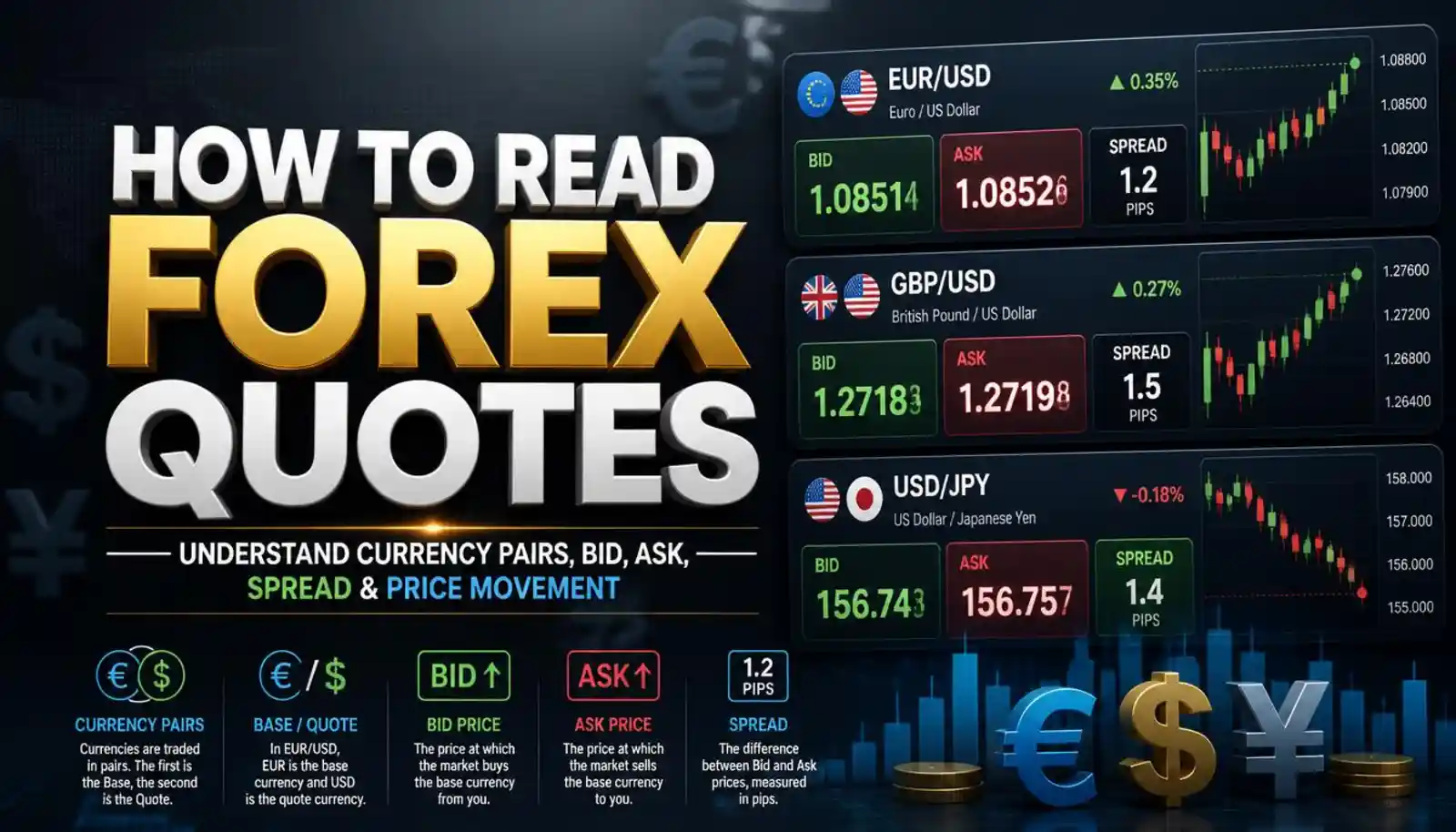
If you want to learn how to read forex quotes, start by identifying the currency pair, the base currency, and the quote currency. For example, EUR/USD = 1.1000 means one euro is valued at 1.10 U.S. dollars.
A forex quote expresses the exchange rate between two currencies, while a two-way market quote can show a bid and an ask price. The difference between those prices is the spread.
How to Read Forex Quotes for Beginners
A currency pair shows two currencies together because forex involves exchanging one currency for another. The first currency is the base currency, and the second is the quote currency. So, in EUR/USD = 1.1000, EUR is the base currency and USD is the quoted currency. The rate means that one euro is priced at 1.10 U.S. dollars.
A simple way to read most standard forex quotes is:
1 unit of the base currency = the displayed amount of the quote currency.
For example, GBP/USD = 1.3500 means one British pound is valued at 1.35 U.S. dollars.
- “A forex quote turns two currency codes into one clear pricing relationship.”
- “Start with the currency pair before studying the number beside it.”
- “The first currency tells you what is being priced.”
- “The second currency tells you what the price is measured in.”
- “EUR/USD becomes easier when you read it as euros priced in dollars.”
- “The exchange rate gives the pair its numerical meaning.”
- “A currency pair is a relationship written with two familiar symbols.”
- “Read the pair first, then ask what one unit of the first currency costs.”
- “The number makes sense only when you know which currencies it belongs to.”
- “Forex reading begins with identifying the two currencies.”
- “One pair can tell you both the market and the exchange-rate relationship.”
- “The base currency leads the pair; the quote currency provides the pricing unit.”
- “A simple quote becomes less intimidating when each symbol has a defined role.”
- “The easiest forex habit is to identify the pair before interpreting its movement.”
- “Understanding the quote is the first step; deciding what to do with it comes later.”
How to Read Base and Quote Currencies
The base currency is the first currency in a standard quoted pair, while the quote currency is the second. For example, in EUR/USD = 1.1000, EUR is the base currency and USD is the quoted currency. If the pair is reversed, the rate represents the opposite relationship. CME describes the first currency as the named or base currency and the second as the terms or quote currency.
For example:
EUR/USD = 1.1000
means:
1 EUR = 1.10 USD
The inverse relationship is approximately:
USD/EUR = 0.9091
meaning one U.S. dollar equals about 0.9091 euros. The order of the currencies therefore matters when interpreting an exchange rate.
- “Base first, quote second—that order gives the price its context.”
- “The base currency is the currency being valued in the pair.”
- “The quoted currency supplies the unit used to express that value.”
- “EUR/USD and USD/EUR describe opposite pricing relationships.”
- “Changing the currency order changes what the displayed number means.”
- “Think of the base currency as the item and the quote currency as its price.”
- “The quote currency acts like the measuring scale for the base currency.”
- “One currency stands first because the rate is built around it.”
- “A pair’s order is information, not decoration.”
- “If you know the base currency, you already know where to begin reading.”
- “The quote currency tells you which money is being used to express the rate.”
- “Currency symbols may look equally important, but their positions give them different roles.”
- “An inverse pair can describe the same relationship from the other direction.”
- “Remembering the order makes exchange-rate examples much easier to understand.”
- “When base and quote become familiar, currency pairs stop looking like secret codes.”
Read Also: 101 Dalmatians Quotes: 101+ Fun, Cute & Spotted Lines
How to Read Bid and Ask Forex Quotes
Forex platforms commonly display a bid and an ask price. From the trader’s perspective, the bid is the price at which you can sell the base currency, while the ask is the price at which you can buy it. The difference between them is the bid-ask spread. Investor.gov describes the ask as the amount needed to purchase a currency and the bid as the lower amount received when selling it.
For example:
EUR/USD: 1.1050 bid / 1.1052 ask
The spread is:
1.1052 − 1.1050 = 0.0002
For a conventional EUR/USD pip value of 0.0001, that difference represents 2 pips.
The bid and ask can change as market conditions change, so the displayed spread is not necessarily constant.
- “Bid and ask are two sides of the same market quote.”
- “The bid is the price associated with selling the base currency.”
- “The ask is the price associated with buying the base currency.”
- “The spread is the distance between those two prices.”
- “A two-price quote becomes simple when each number has a separate role.”
- “If the bid is 1.1050 and the ask is 1.1052, the gap is 0.0002.”
- “The spread turns a pair of nearby numbers into useful market information.”
- “Bid and ask are not duplicate prices; they describe different sides of the transaction.”
- “The ask is normally above the bid in a standard two-way quote.”
- “A narrow-looking difference can still be an important part of transaction cost.”
- “Before interpreting a platform quote, check whether you are viewing bid or ask.”
- “The spread is easier to understand when you calculate the difference yourself.”
- “A currency quote can show two prices because buying and selling have different quoted sides.”
- “Knowing bid and ask makes a trading screen much easier to read.”
- “Once the spread makes sense, the two numbers beside a currency pair stop looking confusing.”
How to Read Pips and Forex Price Changes
A pip is a standard unit used to describe small price movements in forex, although the exact pricing convention can depend on the currency pair and market. In common spot-forex conventions, many major pairs use 0.0001 as one pip, while many JPY pairs use 0.01. Some platforms also display fractional pips.
For example, if EUR/USD moves from:
1.1000 → 1.1050
the difference is:
0.0050 = 50 pips
under the conventional 0.0001 pip convention for EUR/USD.
The monetary value of a pip is a separate question because it depends on factors such as position size and the currency in which the result is measured. A pip tells you about price movement, not automatically about profit or loss.
- “Pips give small forex price movements a common language.”
- “A decimal change becomes easier to discuss when you translate it into pips.”
- “EUR/USD moving from 1.1000 to 1.1050 represents a 50-pip rise under the standard convention.”
- “Pips describe how far a price moved, not how much money you made.”
- “Before counting pips, identify the pair and its pricing convention.”
- “Many JPY pairs use a different conventional pip position from many non-JPY pairs.”
- “A fractional pip can provide extra precision beyond a whole pip.”
- “Not every visible decimal represents a complete pip.”
- “Small price movements can become much easier to compare when expressed in pips.”
- “A pip is a measurement of movement, not a prediction of direction.”
- “A larger pip movement does not automatically mean a larger monetary result.”
- “Position size affects how a price movement translates into money.”
- “The number of pips tells you distance; the trade size helps determine financial impact.”
- “Understanding decimals first makes pip calculations much less confusing.”
- “Once pips make sense, changing forex prices become easier to describe.”
Read Also: Agent Smith Quotes: 90 Original Matrix-Inspired Lines
How to Read Forex Quotes on a Trading Platform
A trading platform may place the currency pair, bid, ask, spread, and other market information close together. A useful reading order is pair → base currency → quote currency → bid/ask → spread → price movement.
For example:
EUR/USD — Bid 1.1050 — Ask 1.1052
can be broken down as:
- Pair: EUR/USD
- Base currency: EUR
- Quote currency: USD
- Bid: 1.1050
- Ask: 1.1052
- Spread: 0.0002, or 2 pips under the conventional EUR/USD pip convention
If you are comparing spot FX with a futures contract, check the specific market’s quotation convention. CME notes that futures and OTC spot FX can use different conventions for some currency pairs.
- “A trading screen may show many numbers, but each one has a different job.”
- “Find the currency pair before interpreting any moving price.”
- “Read the pair first, then identify its base and quote currencies.”
- “Bid and ask become easier to understand when you know which side you are viewing.”
- “A platform quote is information to interpret, not an instruction to trade.”
- “A flashing number deserves context before it deserves a reaction.”
- “Charts show price movement visually; quotes show it numerically.”
- “A crowded market screen becomes simpler when you read one element at a time.”
- “Start with the instrument, then work through the numbers.”
- “The pair tells you what market you are looking at.”
- “The quote tells you how that market is currently being priced.”
- “Always check the quotation convention before comparing different FX products.”
- “A familiar currency can appear differently across different financial instruments.”
- “Good platform habits begin with knowing what every displayed number represents.”
- “Understanding the screen is separate from deciding whether to place a trade.”
How to Read a Forex Quote With Simple Examples
Examples make forex quotes much easier to understand. Suppose GBP/USD = 1.3500. This means one British pound is valued at 1.35 U.S. dollars. If the quote rises to 1.3600, one pound is now being quoted at more U.S. dollars than before. If it falls to 1.3400, one pound is being quoted at fewer U.S. dollars.
The direction must always be interpreted in the context of the pair. Investor.gov notes that forex quotation conventions are not completely uniform across currencies, markets, and systems, which is why identifying the pair is essential.
Another example is:
USD/JPY = 150.00
This expresses the value of one U.S. dollar in Japanese yen under that quotation.
- “GBP/USD at 1.3500 means one pound is priced at 1.35 U.S. dollars.”
- “When GBP/USD rises, more dollars are quoted for one pound.”
- “When GBP/USD falls, fewer dollars are quoted for one pound.”
- “USD/JPY at 150.00 expresses one U.S. dollar in Japanese yen.”
- “A price only tells its full story when you know which pair produced it.”
- “Compare the same pair at two prices to see how its quoted relationship changes.”
- “EUR/USD at 1.1000 and 1.1100 represent different exchange-rate levels for the same pair.”
- “A rising number does not have the same interpretation for every possible quotation.”
- “The first currency gives you the reference point for reading the rate.”
- “Examples turn currency codes into relationships you can explain in plain English.”
- “A forex quote is easier to remember when you can translate it into one simple sentence.”
- “If one euro buys more dollars than before, the EUR/USD quote has increased.”
- “If one euro buys fewer dollars than before, the EUR/USD quote has decreased.”
- “A currency pair provides the context that makes its price meaningful.”
- “The best way to learn a forex quote is to explain what one unit of the base currency buys.”
Read Also: Anime Quotes Funny: 90 Original Lines to Make You Laugh
FAQs About How to Read Forex Quotes
What is a forex quote?
A forex quote shows the exchange rate between two currencies. It tells you how much of the quote currency is needed to equal one unit of the base currency.
How do you read EUR/USD?
If EUR/USD = 1.1000, it means one euro is valued at 1.10 U.S. dollars. EUR is the base currency, and USD is the quote currency.
What is the base currency in a forex quote?
The base currency is the first currency listed in a currency pair. In GBP/USD, GBP is the base currency.
What is the quote currency?
The quote currency is the second currency in a forex pair. In GBP/USD, USD is the quote currency and expresses the value of one pound.
What do bid and ask mean in forex?
The bid is the price at which you can sell the base currency, while the ask is the price at which you can buy it. The difference between them is the spread.
What is the spread in forex?
The spread is the difference between the bid and ask prices. For example, a bid of 1.1050 and an ask of 1.1052 create a spread of 0.0002, or 2 pips under the conventional EUR/USD pip convention.
What is a pip in forex?
A pip is a standard unit for describing small forex price movements. Many major currency pairs use 0.0001 as one pip, while many JPY pairs use 0.01 under common spot-FX conventions.
What does it mean when a forex quote goes up?
It means the base currency is being quoted at a higher value relative to the quote currency. For example, if GBP/USD rises from 1.3500 to 1.3600, one pound is quoted at more U.S. dollars.
Why does the order of currencies matter in forex?
The order determines which currency is the base and which is the quote currency. EUR/USD and USD/EUR therefore represent different quotation relationships.
Can forex quotes have different conventions?
Yes. Quotation conventions can vary across currencies, markets, trading systems, and financial products. Always identify the currency pair and the specific market before interpreting a quote.
Conclusion
Learning how to read forex quotes becomes much easier when you use the same sequence each time: identify the currency pair, determine the base and quote currencies, interpret the exchange rate, then check the bid, ask, spread, and pip movement. Always read the pair before interpreting whether its price has risen or fallen, because the currency order determines what the number means. Use these original lines as study reminders, captions, or conversation starters, and share your favorites with friends who are learning forex too.

1 thought on “How to Read Forex Quotes: A Simple Guide”